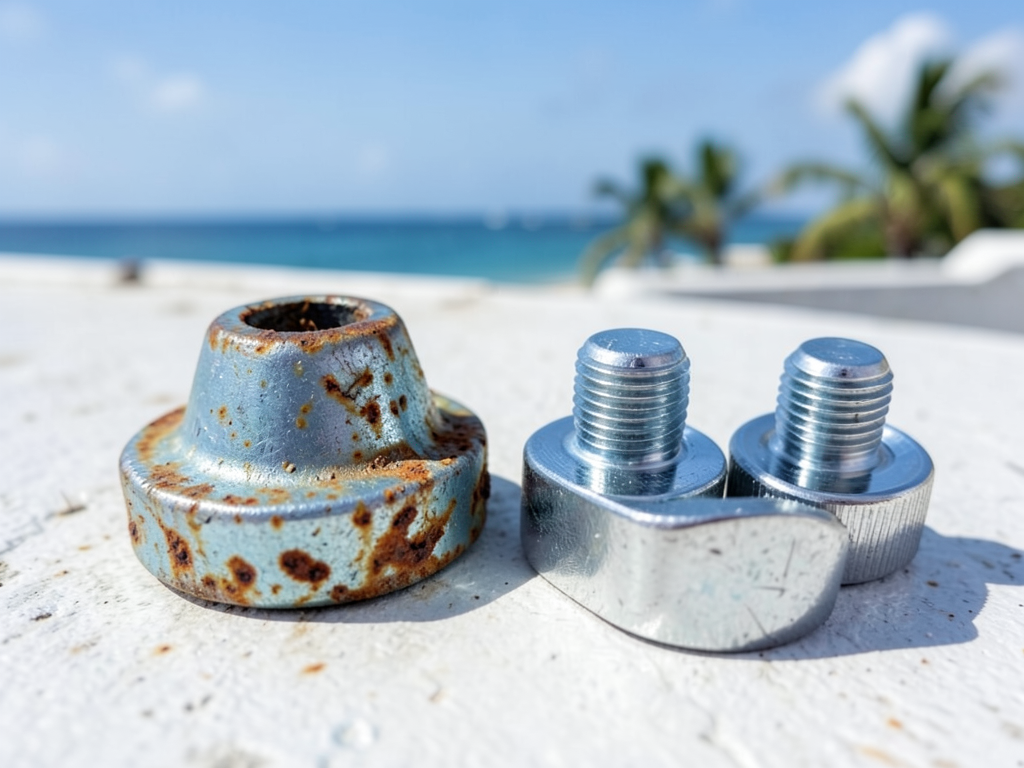
Living in Gables by the Sea means your roof faces relentless salt spray from Biscayne Bay every single day. Standard galvanized fasteners start corroding within three years and fail completely by year five. That’s when your roof deck becomes vulnerable to wind uplift and water intrusion during Miami’s frequent tropical storms.
316-grade marine stainless steel fasteners resist salt corrosion 30 times better than standard galvanized options. They maintain structural integrity for 30+ years even in direct coastal exposure. The difference between a failed roof and one that survives hurricane season comes down to the metal holding your shingles or tiles in place. The Best Metal Roofing Options for Homes in Key Biscayne.
Florida Building Code requires specific fastener ratings for Miami-Dade’s High-Velocity Hurricane Zone. Standard hardware store fasteners won’t meet these requirements. Your roof needs fasteners tested to TAS 114 pull-out standards with documented shear strength ratings. Miami-Dade Notice of Acceptance (NOA) Program.
Why 316 Grade Stainless Steel is Mandatory for Coastal Miami Properties
The salt content in Biscayne Bay air creates a corrosive environment that destroys standard fasteners within 3-5 years. You can see this damage on older homes along San Pedro Avenue where rusted nail heads create visible streaks down roof faces. Once corrosion starts, water intrusion follows within months.
316-grade stainless contains molybdenum that blocks salt penetration at the molecular level. This alloy resists chloride-induced pitting that destroys 304-grade fasteners in coastal environments. The molybdenum content costs about 20% more but extends fastener life from 5 years to 30+ years.
During a recent inspection on Arvida Parkway, we found 70% of fasteners on a five-year-old roof already showing surface rust. The homeowner had no idea standard galvanized nails were failing until we pulled up a few shingles. This is common in Gables by the Sea where ocean breezes carry salt particles inland up to one mile.
Call (645) 231-4888 today to schedule your inspection before the next storm hits.
304 vs. 316 Grade: Technical Comparison for High-Salt Environments
304-grade stainless contains 18% chromium and 8% nickel. It works fine for inland Miami areas but fails in coastal zones where salt concentration exceeds 500 parts per million. The chromium oxide layer breaks down under constant salt exposure, allowing pitting corrosion to begin.
316-grade stainless adds 2-3% molybdenum to the alloy. This creates a more stable passive layer that resists chloride attack. In ASTM B117 salt spray testing, 304-grade shows red rust after 200 hours while 316-grade remains intact beyond 1,000 hours. ASTM B117 Salt Spray Testing Standards.
The cost difference is minimal for fasteners – about $0.15 more per screw. But the performance difference is massive. A 304 screw in Gables by the Sea might last 5 years. A 316 screw lasts the lifetime of your roof. Over 30 years, you’d replace 304 fasteners six times versus zero replacements with 316.
Shear strength also matters. 316-grade maintains 70,000 PSI tensile strength even after decades of salt exposure. 304-grade loses 40% of its strength within 8 years in coastal environments. That’s the difference between a fastener that holds during a Category 3 hurricane and one that shears off completely. Protecting Your Home with Hurricane Rated Roofing Systems in Miami.
Hurricane Compliance: Meeting Miami-Dade NOA Standards
Miami-Dade Notice of Acceptance (NOA) requirements specify exact fastener pull-out resistance for different wind zones. Gables by the Sea falls in Wind Zone III, requiring minimum 300-pound pull-out strength for roof fasteners. Standard nails provide only 80-120 pounds of resistance.
TAS 114 testing measures fastener performance under simulated hurricane conditions. Approved fasteners must maintain 90% of original pull-out strength after 2,000 hours of salt spray exposure. This eliminates most standard galvanized options immediately.
The Florida Building Code Chapter 15 mandates secondary water barriers for homes built after 2007. These barriers rely on fastener integrity to prevent uplift. If your fasteners corrode, the barrier fails regardless of how well it was installed.
During Hurricane Irma in 2017, homes with non-compliant fasteners lost an average of 15-20 shingles per 100 square feet. Homes with proper 316-grade fasteners lost fewer than 2 shingles per 100 square feet. The difference in repair costs was $8,000 versus $300. Professional Flat Roof Repair Services for Brickell Business Owners.
Preventing Galvanic Corrosion in Metal Roofing Systems
Galvanic corrosion occurs when dissimilar metals contact in the presence of an electrolyte like salt water. If you install aluminum roofing with galvanized fasteners, the zinc coating sacrifices itself to protect the aluminum. Within 2-3 years, your fasteners become paper-thin and fail completely. Roofing Cutler Bay.
316-grade stainless has a noble potential similar to aluminum, preventing galvanic action. The passive chromium oxide layer on both metals creates a barrier that blocks electron transfer. This compatibility is why marine applications worldwide use 316 stainless with aluminum components.
We recently replaced a metal roof on Hardee Road where the homeowner had used standard galvanized screws with aluminum panels. After three years, every fastener head showed white corrosion products. The aluminum panels were fine, but the fasteners had completely deteriorated.
EPDM washers provide another protection layer. These synthetic rubber washers seal around fastener penetrations and isolate metal-to-metal contact. Quality EPDM maintains flexibility for 20+ years, while cheap washers crack within 5 years and allow water intrusion at every fastener point.
Proper Installation Techniques to Ensure Warranty Protection
Torque settings matter as much as fastener grade. Over-tightening stainless screws work-hardens the metal and creates stress points that accelerate corrosion. Under-tightening leaves gaps that allow water infiltration and wind uplift. The correct torque for 316 stainless in wood is 18-22 inch-pounds.
Self-drilling points eliminate pre-drilling requirements but must match substrate density. Using a fine-point screw in dense tropical hardwood splits the material and compromises holding power. Coarse-point screws in soft pine under-penetrate and strip easily.
Fastener spacing follows strict patterns based on wind exposure and roof slope. In Gables by the Sea’s Wind Zone III, tile roofs require fasteners every 6 inches along eave edges and every 12 inches in field areas. Skipping these requirements voids manufacturer warranties immediately.
Penetration depth affects performance significantly. Fasteners must penetrate at least 3/4 inch into wood or through the full thickness of metal substrates. Shallow penetrations create leverage points where wind forces concentrate and cause fastener pull-through.
Cost-Benefit Analysis: Initial Investment vs. Long-Term Protection
Standard galvanized fasteners cost $0.08-0.12 each. 316-grade stainless costs $0.20-0.25 each. For a 2,000-square-foot roof requiring 4,000 fasteners, the difference is $480-520 upfront.
Over 30 years, galvanized fasteners require replacement 5-6 times at $300-400 per replacement plus labor costs. That’s $2,100-2,800 in replacement costs alone. Add the cost of water damage from fastener failures – typically $5,000-15,000 per incident – and the total cost of ownership becomes clear.
Insurance companies increasingly require documentation of fastener compliance for coverage in coastal zones. Some providers offer premium discounts for 316-grade installations. Others may deny claims for damage caused by non-compliant fasteners, leaving homeowners responsible for full repair costs. Why Homeowners in Coral Gables Choose Professional Tile Roof Installation.
Energy efficiency also improves with proper fastener installation. Loose fasteners create thermal gaps that increase cooling costs by 3-5% annually. Tight, corrosion-resistant fasteners maintain roof system integrity and energy performance throughout their service life.
Installation Checklist: Tools and Techniques for Success
Impact drivers with adjustable clutches prevent over-torquing. Standard drills apply inconsistent pressure that either strips screws or creates stress fractures. Battery-powered impact drivers maintain consistent torque across thousands of fasteners.
Depth stops on drill bits ensure uniform penetration. Without depth control, some fasteners barely penetrate while others go too deep and damage underlayment. Pre-set stops eliminate this variability and ensure every fastener meets code requirements.
Moisture meters verify wood substrate readiness. Installing fasteners in wood with moisture content above 19% guarantees future corrosion regardless of fastener grade. Tropical hardwoods in Gables by the Sea often retain moisture from morning dew and afternoon thunderstorms.
Quality control inspection involves pull-testing random fasteners during installation. Using a calibrated torque wrench, technicians verify each fastener achieves minimum pull-out strength before covering with roofing materials. This catches installation errors before they become expensive problems.
Local Compliance: Miami-Dade TAS 114 Requirements
Miami-Dade TAS 114 testing requires fasteners to maintain 90% of original pull-out strength after 2,000 hours of salt spray exposure per ASTM B117 standards. This translates to approximately 12 weeks of continuous salt fog testing that simulates 15-20 years of coastal exposure.
Approved fasteners must also pass 110 mph wind uplift testing with no fastener withdrawal or head pull-through. Gables by the Sea’s exposure to Biscayne Bay winds means your fasteners need documented performance at these wind speeds, not just standard residential ratings.
The Florida Building Commission maintains a list of approved fasteners with specific NOA numbers. Using non-approved fasteners, even if they appear similar, creates liability for contractors and voids homeowner insurance coverage in many cases.
Building inspectors check fastener compliance during final inspections. They verify spacing patterns, pull-out ratings, and corrosion resistance documentation. Missing documentation or non-compliant fasteners can result in failed inspections and costly re-installation requirements.
Frequently Asked Questions
Can I use aluminum fasteners instead of stainless steel?
Aluminum fasteners work in some applications but lack the shear strength needed for Miami’s wind zones. They also corrode when in contact with pressure-treated lumber due to galvanic action. 316 stainless provides better overall performance for coastal roofing applications.
How long do stainless steel fasteners actually last in coastal Miami?
316-grade stainless fasteners last 30+ years in direct coastal exposure. We’ve inspected roofs in Coral Gables installed 25 years ago where the fasteners still show no signs of corrosion. The limiting factor becomes the roofing material itself, not the fasteners.
Are stainless steel fasteners worth the extra cost?
Yes. The $500-600 upfront difference saves $2,000-3,000 in replacement costs over 30 years plus prevents potential water damage costing $5,000-15,000 per incident. Insurance compliance and warranty protection add additional value that’s difficult to quantify but critical for coastal homeowners.
Don’t wait for the next storm to discover your fasteners have failed. Call (645) 231-4888 today for a professional inspection and protect your Gables by the Sea home with marine-grade stainless steel fasteners.
{
“@context”: “https://schema.org”,
“@type”: “BlogPosting”,
“headline”: “Why Your Gables by the Sea Property Needs Stainless Steel Roof Fasteners”,
“description”: “Salt-air corrosion destroys standard fasteners in 3-5 years. Learn why 316-grade stainless steel is mandatory for Miami’s coastal homes and how to protect your roof.”,
“wordCount”: 1681,
“datePublished”: “2026-06-13T08:25:00.000Z”,
“dateModified”: “2026-06-13T08:25:00.000Z”,
“inLanguage”: “en-US”,
“mainEntityOfPage”: {
“@type”: “WebPage”,
“@id”: “https://ironwoodroofingmiami.com”
},
“publisher”: {
“@type”: “LocalBusiness”,
“name”: “Ironwood Roofing Miami”,
“url”: “https://ironwoodroofingmiami.com”
},
“author”: {
“@type”: “Organization”,
“name”: “Ironwood Roofing Miami”,
“url”: “https://ironwoodroofingmiami.com”
},
“image”: {
“@type”: “ImageObject”,
“url”: “https://ironwoodroofingmiami.com/wp-content/uploads/2026/03/why-your-gables-by-the-sea-property-needs-stainles-1.png”
}
}
{
“@context”: “https://schema.org”,
“@type”: “RoofingContractor”,
“name”: “Ironwood Roofing Miami”,
“url”: “https://ironwoodroofingmiami.com”,
“address”: {
“@type”: “PostalAddress”,
“addressLocality”: “Miami”
},
“areaServed”: {
“@type”: “City”,
“name”: “Miami”
}
}
{
“@context”: “https://schema.org”,
“@type”: “FAQPage”,
“mainEntity”: [
{
“@type”: “Question”,
“name”: “Can I use aluminum fasteners instead of stainless steel?”,
“acceptedAnswer”: {
“@type”: “Answer”,
“text”: “Aluminum fasteners work in some applications but lack the shear strength needed for Miami’s wind zones. They also corrode when in contact with pressure-treated lumber due to galvanic action. 316 stainless provides better overall performance for coastal roofing applications.”
}
},
{
“@type”: “Question”,
“name”: “How long do stainless steel fasteners actually last in coastal Miami?”,
“acceptedAnswer”: {
“@type”: “Answer”,
“text”: “316-grade stainless fasteners last 30+ years in direct coastal exposure. We’ve inspected roofs in Coral Gables installed 25 years ago where the fasteners still show no signs of corrosion. The limiting factor becomes the roofing material itself, not the fasteners.”
}
},
{
“@type”: “Question”,
“name”: “Are stainless steel fasteners worth the extra cost?”,
“acceptedAnswer”: {
“@type”: “Answer”,
“text”: “Yes. The $500-600 upfront difference saves $2,000-3,000 in replacement costs over 30 years plus prevents potential water damage costing $5,000-15,000 per incident. Insurance compliance and warranty protection add additional value that’s difficult to quantify but critical for coastal homeowners.”
}
}
]
}
{
“@context”: “https://schema.org”,
“@type”: “BreadcrumbList”,
“itemListElement”: [
{
“@type”: “ListItem”,
“position”: 1,
“name”: “Home”,
“item”: “https://ironwoodroofingmiami.com”
},
{
“@type”: “ListItem”,
“position”: 2,
“name”: “Blog”,
“item”: “https://ironwoodroofingmiami.com/blog”
},
{
“@type”: “ListItem”,
“position”: 3,
“name”: “Why Your Gables by the Sea Property Needs Stainless Steel Roof Fasteners”
}
]
}
{
“@context”: “https://schema.org”,
“@type”: “Service”,
“serviceType”: “Roofing”,
“provider”: {
“@type”: “LocalBusiness”,
“name”: “Ironwood Roofing Miami”,
“url”: “https://ironwoodroofingmiami.com”
},
“areaServed”: {
“@type”: “City”,
“name”: “Miami”
},
“description”: “Salt-air corrosion destroys standard fasteners in 3-5 years. Learn why 316-grade stainless steel is mandatory for Miami’s coastal homes and how to protect your roof.”
}