
The Hidden Risks of Leaving Ponding Water on Your Westchester Flat Roof
Standing water on your Westchester flat roof isn’t just an eyesore after Miami’s afternoon thunderstorms. When water sits for more than 48 hours, it becomes a serious threat to your home’s structural integrity, creating conditions that accelerate roof membrane degradation, promote dangerous mold growth, and attract disease-carrying mosquitoes. Miami’s flat-roofed mid-century homes, common in Westchester, are particularly vulnerable to these hidden risks that many homeowners don’t discover until it’s too late. Why Homeowners in Coral Gables Choose Professional Tile Roof Installation.
The combination of Miami’s 67 inches of annual rainfall and Westchester’s aging roof infrastructure creates a perfect storm for ponding problems. What starts as a small puddle after a summer downpour can quickly evolve into thousands of pounds of extra weight pressing down on your roof deck, forcing structural members to deflect and creating even more low spots where water collects. This vicious cycle continues until you address the underlying drainage issues.
Understanding these risks is the first step toward protecting your investment. From the Florida Building Code’s specific requirements for secondary drainage systems to the unique challenges posed by Miami’s salt air and UV exposure, this guide breaks down exactly what’s happening under that standing water and what you can do about it before your next tropical storm hits. Florida Building Code Section 1511.
The 48-Hour Rule: When Standing Water Becomes a Problem
The roofing industry defines ponding water as any water that remains on a roof surface for more than 48 hours after precipitation ends. This timeframe matters because it marks the point where water transitions from a temporary condition to a structural and material threat. In Miami’s humid climate, where evaporation rates are slower due to high moisture content in the air, that 48-hour window can easily extend to several days. The Best Metal Roofing Options for Homes in Key Biscayne.
During this extended contact time, water begins to work on your roof through multiple mechanisms. First, it adds significant weight. One inch of standing water across a 1,000-square-foot area weighs approximately 520 pounds. Multiple low spots collecting several inches of water can add thousands of pounds of stress to roof joists and decking that weren’t designed to handle that kind of constant, distributed load.. Read more about Why Multi Story Condos in North Bay Village Need High Performance Liquid Applied Membranes.
Second, the water acts as a magnifying glass for UV radiation. In Miami’s intense sunlight, water droplets can concentrate UV rays onto the roof membrane below, accelerating the breakdown of roofing materials. This creates a paradox where the very thing protecting your home from rain is being destroyed by the sun through the medium of standing water. Protecting Your Home with Hurricane Rated Roofing Systems in Miami.

Diagram showing the 48-hour timeline of ponding water damage progression, from initial weight stress to UV magnification effects and biological growth.
Why Miami Roofs Are Prone to Ponding
Westchester’s mid-century modern homes, built primarily between the 1950s and 1970s, feature flat roof designs that were popular during Miami’s post-war development boom. These roofs typically have minimal slope, often less than 1/4 inch per foot, which is barely enough to shed water during normal conditions. When these roofs age and structural members begin to deflect under their own weight, the slope can become even less effective.
Miami’s tropical climate creates additional challenges that flat roofs in other regions don’t face. Afternoon thunderstorms can dump several inches of rain in under an hour, overwhelming drainage systems designed for more moderate rainfall patterns. The intense heat causes roofing materials to expand and contract, creating gaps and low spots where water can collect. Salt air from Biscayne Bay accelerates the corrosion of metal components in drainage systems, reducing their effectiveness over time.
The soil composition in Westchester, part of Miami’s coastal ridge system, includes layers of limestone and marl that can shift slightly over decades. This subtle ground movement can cause foundation settlement that affects the entire structure, including roof planes. What started as a perfectly flat roof 50 years ago may now have multiple low spots where water naturally collects.
Many Westchester homes also feature parapet walls around their flat roof sections. While these walls provide wind protection and a finished appearance, they can trap water if the scuppers or internal drains become blocked by debris or fail due to age. The combination of parapet walls and minimal roof slope creates ideal conditions for ponding water to form and persist.
Risks of Ignoring Standing Water in South Florida
The structural risks of ponding water extend far beyond simple leaks. When water sits on your roof for extended periods, it creates a hydrostatic load that can cause permanent deformation of roof decking. Wood decks may begin to rot from constant moisture exposure, while concrete decks can develop cracks from the freeze-thaw cycle that occurs when water expands slightly during cooler nights.
In Westchester’s older homes, many of which feature wood-framed roof structures, this constant moisture exposure can lead to rot in critical structural members. The fascia boards, often made of untreated wood in mid-century construction, are particularly vulnerable. Once rot sets in, it spreads rapidly through the damp wood, compromising the roof’s edge and creating entry points for water and pests.
The biological risks are equally concerning in Miami’s climate. Standing water creates perfect breeding conditions for mosquitoes, including species that carry diseases like West Nile virus and Zika. Miami-Dade County’s warm, humid environment allows mosquito larvae to develop in as little as five days, meaning a puddle that forms after Monday’s storm could be producing adult mosquitoes by Saturday. Miami-Dade County HVHZ requirements.
Mold and algae growth accelerate dramatically in ponding conditions. Miami’s humidity provides the moisture these organisms need, while the standing water provides a stable environment for colonization. Once established, mold can spread to the interior of your home through small gaps in the roofing system, creating health hazards and expensive remediation requirements.
The chemical risks are often overlooked but significant. Miami’s proximity to the ocean means that rainwater contains dissolved salts and other minerals. When this water evaporates from your roof surface, it leaves behind concentrated deposits that can corrode metal flashings, degrade roofing membranes, and create acidic conditions that accelerate material breakdown.
Miami-Dade Building Code & Roof Drainage
The Florida Building Code, specifically Section 1511 covering recovering versus replacement of roof coverings, establishes strict requirements for addressing ponding conditions. When more than 25 percent of a roof area exhibits ponding, the code requires either complete replacement or installation of a tapered insulation system to create positive drainage. This isn’t optional maintenance; it’s a code compliance issue that can affect your ability to sell your home or obtain insurance.
Miami-Dade County adds another layer of requirements through its High Velocity Hurricane Zone (HVHZ) provisions. All roofing work in Westchester must comply with TAS 114 testing standards, which evaluate a roofing system’s ability to resist wind uplift and prevent water infiltration. These tests become even more critical when addressing ponding issues, as standing water can increase wind uplift pressures on roofing membranes.
The code also mandates secondary (overflow) drainage systems for all flat roofs. These systems must be sized to handle the volume of water that would accumulate if primary drains became completely blocked. In Westchester’s older homes, many of these secondary systems are undersized or have been modified over the years in ways that don’t meet current code requirements.
Scupper requirements under Miami-Dade regulations specify minimum opening sizes based on roof area and rainfall intensity. For a typical Westchester home with a 1,500-square-foot flat roof section, scuppers must provide at least 12 square inches of clear opening per side to handle Miami’s design rainfall intensity of 5 inches per hour. Many existing scuppers in the area fall short of these requirements.
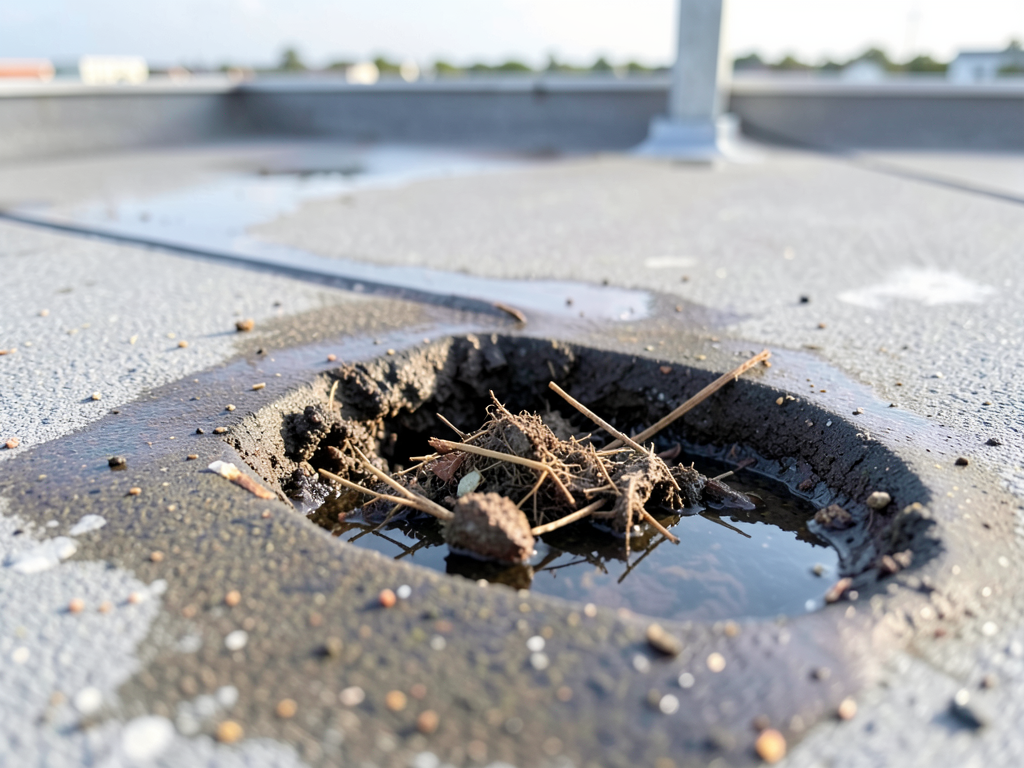
Photo showing a Miami-Dade NOA-approved tapered insulation system installation on a Westchester flat roof, with proper slope and drainage integration.
Professional Solutions for Flat Roof Drainage
Addressing ponding water requires a systematic approach that starts with accurate diagnosis. Professional roofers use laser levels and digital slope finders to map your roof’s low spots with precision. This diagnostic process reveals not just where water collects, but why it collects there. Is it a structural deflection, a design flaw, or a combination of both? Professional Flat Roof Repair Services for Brickell Business Owners.
Tapered insulation systems represent the most comprehensive solution for Westchester’s flat roofs. These systems use pre-molded foam panels that create a gentle slope, typically 1/8 to 1/4 inch per foot, directing water toward drains or scuppers. The insulation provides the dual benefit of improving energy efficiency while solving drainage problems. Modern tapered systems can achieve slopes that weren’t possible with traditional built-up roofing methods.
For homes where complete tapered insulation replacement isn’t immediately feasible, roof crickets offer a targeted solution. These small, strategically placed tapered sections divert water around chimneys, HVAC units, and other roof penetrations that often create ponding conditions. A properly designed cricket can eliminate multiple problem areas without the cost of a complete roof overhaul.
Drain clearing and upgrade represents another critical service. Many Westchester homes have drains that are partially blocked by decades of debris, or have deteriorated to the point where they can’t handle current rainfall volumes. Professional drain cleaning involves removing all debris, inspecting the drain body for damage, and often replacing the clamping ring and strainer to ensure proper water flow.
Modified bitumen and TPO roofing membranes offer superior ponding resistance compared to traditional built-up roofing. These single-ply systems feature heat-welded seams that create a monolithic waterproof layer. When installed over a properly sloped substrate, they provide excellent long-term performance in Miami’s challenging climate. The white reflective surface of TPO also helps reduce heat gain, lowering cooling costs.
>
Preventing Future Ponding Problems
Prevention starts with regular maintenance. Miami’s flat roofs should be inspected at least twice yearly, typically in spring before hurricane season and in fall after the summer rainy season. These inspections should include clearing all drains and scuppers of debris, checking for signs of membrane deterioration, and verifying that all slope-creating elements remain intact.
Gutter and downspout maintenance plays a crucial role in preventing roof ponding. When water can’t exit the roof system efficiently, it backs up and creates additional stress on the entire drainage network. Downspouts should be checked for proper connection to underground drainage systems, and all connections should be watertight to prevent water from seeping back under the roof edge.
Tree management around your Westchester home can significantly impact roof drainage. Overhanging branches drop leaves and twigs that clog drains and scuppers. During storms, branches can damage roofing materials, creating openings where water can penetrate. Keeping trees trimmed back at least 10 feet from your roof edge reduces these risks while still providing shade benefits.
Interior signs of potential ponding problems include ceiling stains that appear after heavy rains, particularly in the center of rooms below flat roof sections. These stains often indicate that water is finding its way through small gaps in the roofing system created by the constant stress of ponding. By the time you see these interior signs, the exterior damage is usually extensive. Finding a Reliable Roof Repair Company in Coconut Grove.
Professional moisture scanning can detect water intrusion before it becomes visible. Using infrared cameras and moisture meters, technicians can identify areas where water is accumulating under the roofing surface. This early detection allows for targeted repairs before the problem spreads to adjacent areas of your roof.
Before and after comparison showing a Westchester flat roof before and after professional drainage correction, with water flow paths clearly marked.
Next Steps: Request a Miami Roof Inspection
If you’re seeing standing water on your Westchester flat roof after Miami’s afternoon thunderstorms, don’t wait for the next tropical system to reveal the full extent of the problem. The 48-hour rule means that water sitting on your roof right now is already beginning to cause damage that will only get worse with time.
A professional roof inspection includes thermal imaging to detect moisture intrusion, laser leveling to map slope variations, and a complete assessment of your drainage system’s capacity. We’ll provide you with a detailed report showing exactly where water collects, why it collects there, and what solutions will permanently fix the problem.
Ironwood Roofing Miami serves Westchester and all surrounding communities including Coral Gables, Doral, and Coconut Grove. Our team understands the unique challenges of Miami’s flat roof systems and the specific requirements of the Florida Building Code. We’re not just fixing leaks; we’re preventing the structural damage that leads to them.
Call (645) 231-4888 today to schedule your comprehensive roof inspection. Don’t let another afternoon thunderstorm add more weight and stress to your roof structure. Pick up the phone and call (645) 231-4888 before the next storm hits. Your roof’s structural integrity and your family’s peace of mind are worth the call.
Frequently Asked Questions
How much does it cost to fix ponding water on a flat roof?
The cost varies significantly based on the extent of the problem and the chosen solution. Simple drain cleaning might cost a few hundred dollars, while a complete tapered insulation system installation typically ranges from $8 to $15 per square foot. Most Westchester homeowners find that addressing ponding issues early prevents much more expensive repairs later.
Can I fix ponding water myself?
While you can clear debris from drains and scuppers yourself, addressing the underlying causes of ponding usually requires professional expertise. Creating proper slope, ensuring code compliance, and installing drainage systems correctly involves specialized knowledge of Miami’s building requirements and roofing systems. DIY attempts often lead to temporary fixes that fail during the next heavy rain.
How long does a tapered insulation system last?
When properly installed over a sound roof deck, tapered insulation systems typically last 20 to 30 years. The actual lifespan depends on factors like UV exposure, foot traffic, and maintenance. Miami’s intense sun and frequent storms can reduce this slightly, which is why professional installation and regular maintenance are crucial for maximizing your investment.
Will fixing ponding water improve my home’s energy efficiency?
Yes, absolutely. Many ponding solutions, particularly tapered insulation systems, add insulation value to your roof. This can reduce heat transfer through your roof by 30 to 50 percent, lowering cooling costs significantly. The white reflective surface of many modern roofing membranes also reduces heat absorption, providing additional energy savings during Miami’s long cooling season.
{
“@context”: “https://schema.org”,
“@type”: “BlogPosting”,
“headline”: “The Hidden Risks of Leaving Ponding Water on Your Westchester Flat Roof”,
“description”: “Learn how ponding water damages Westchester flat roofs in Miami’s tropical climate. Discover code requirements, structural risks, and permanent drainage solutions.”,
“wordCount”: 2402,
“datePublished”: “2026-04-01T13:30:00.000Z”,
“dateModified”: “2026-04-01T13:30:00.000Z”,
“inLanguage”: “en-US”,
“mainEntityOfPage”: {
“@type”: “WebPage”,
“@id”: “https://ironwoodroofingmiami.com”
},
“publisher”: {
“@type”: “LocalBusiness”,
“name”: “Ironwood Roofing Miami”,
“url”: “https://ironwoodroofingmiami.com”
},
“author”: {
“@type”: “Organization”,
“name”: “Ironwood Roofing Miami”,
“url”: “https://ironwoodroofingmiami.com”
},
“image”: {
“@type”: “ImageObject”,
“url”: “https://ironwoodroofingmiami.com/wp-content/uploads/2026/03/the-hidden-risks-of-leaving-ponding-water-on-your-1.png”
}
}
{
“@context”: “https://schema.org”,
“@type”: “RoofingContractor”,
“name”: “Ironwood Roofing Miami”,
“url”: “https://ironwoodroofingmiami.com”,
“address”: {
“@type”: “PostalAddress”,
“addressLocality”: “Miami”
},
“areaServed”: {
“@type”: “City”,
“name”: “Miami”
}
}
{
“@context”: “https://schema.org”,
“@type”: “FAQPage”,
“mainEntity”: [
{
“@type”: “Question”,
“name”: “How much does it cost to fix ponding water on a flat roof?”,
“acceptedAnswer”: {
“@type”: “Answer”,
“text”: “The cost varies significantly based on the extent of the problem and the chosen solution. Simple drain cleaning might cost a few hundred dollars, while a complete tapered insulation system installation typically ranges from $8 to $15 per square foot. Most Westchester homeowners find that addressing ponding issues early prevents much more expensive repairs later.”
}
},
{
“@type”: “Question”,
“name”: “Can I fix ponding water myself?”,
“acceptedAnswer”: {
“@type”: “Answer”,
“text”: “While you can clear debris from drains and scuppers yourself, addressing the underlying causes of ponding usually requires professional expertise. Creating proper slope, ensuring code compliance, and installing drainage systems correctly involves specialized knowledge of Miami’s building requirements and roofing systems. DIY attempts often lead to temporary fixes that fail during the next heavy rain.”
}
},
{
“@type”: “Question”,
“name”: “How long does a tapered insulation system last?”,
“acceptedAnswer”: {
“@type”: “Answer”,
“text”: “When properly installed over a sound roof deck, tapered insulation systems typically last 20 to 30 years. The actual lifespan depends on factors like UV exposure, foot traffic, and maintenance. Miami’s intense sun and frequent storms can reduce this slightly, which is why professional installation and regular maintenance are crucial for maximizing your investment.”
}
},
{
“@type”: “Question”,
“name”: “Will fixing ponding water improve my home’s energy efficiency?”,
“acceptedAnswer”: {
“@type”: “Answer”,
“text”: “Yes, absolutely. Many ponding solutions, particularly tapered insulation systems, add insulation value to your roof. This can reduce heat transfer through your roof by 30 to 50 percent, lowering cooling costs significantly. The white reflective surface of many modern roofing membranes also reduces heat absorption, providing additional energy savings during Miami’s long cooling season.”
}
}
]
}
{
“@context”: “https://schema.org”,
“@type”: “BreadcrumbList”,
“itemListElement”: [
{
“@type”: “ListItem”,
“position”: 1,
“name”: “Home”,
“item”: “https://ironwoodroofingmiami.com”
},
{
“@type”: “ListItem”,
“position”: 2,
“name”: “Blog”,
“item”: “https://ironwoodroofingmiami.com/blog”
},
{
“@type”: “ListItem”,
“position”: 3,
“name”: “The Hidden Risks of Leaving Ponding Water on Your Westchester Flat Roof”
}
]
}
{
“@context”: “https://schema.org”,
“@type”: “Service”,
“serviceType”: “Roofing”,
“provider”: {
“@type”: “LocalBusiness”,
“name”: “Ironwood Roofing Miami”,
“url”: “https://ironwoodroofingmiami.com”
},
“areaServed”: {
“@type”: “City”,
“name”: “Miami”
},
“description”: “Learn how ponding water damages Westchester flat roofs in Miami’s tropical climate. Discover code requirements, structural risks, and permanent drainage solutions.”
}