Why Allapattah Homes Face Unique Roof Decking Damage
Living in Allapattah means dealing with Miami-Dade’s notorious humidity that consistently hovers above 90% during summer months. This relentless moisture creates perfect conditions for wood rot to develop in roof decking, especially in older homes built before modern ventilation standards. The combination of salt air from nearby Biscayne Bay, afternoon thunderstorms, and poor attic airflow accelerates the deterioration process beyond what most homeowners realize. Miami-Dade County Building Services.
Many Allapattah properties were constructed between the 1950s and 1970s using standard plywood sheathing that wasn’t designed to withstand today’s climate extremes. When water penetrates through aging shingles or flashing failures, the trapped moisture has nowhere to escape in these enclosed attic spaces. The result is a slow but destructive process where fungal growth breaks down the wood fibers, creating soft spots that compromise your roof’s structural integrity.
The problem becomes particularly severe in Allapattah’s older residential pockets where homes share similar construction methods and age. Properties near NW 22nd Avenue and NW 17th Avenue often experience the worst conditions due to their proximity to industrial areas that generate additional heat and moisture. Without proper intervention, what starts as minor discoloration can progress to complete deck failure within just a few rainy seasons.

Warning Signs Your Roof Decking Is Failing
Identifying rotting roof decking early can save thousands in emergency repairs. The first indicator most homeowners notice is a spongy feel when walking across certain areas of the roof. This occurs because the wood has lost its structural rigidity and can no longer support normal weight loads. You might also observe visible sagging between rafters, creating an uneven surface that collects water instead of shedding it. Professional Flat Roof Repair Services for Brickell Business Owners.
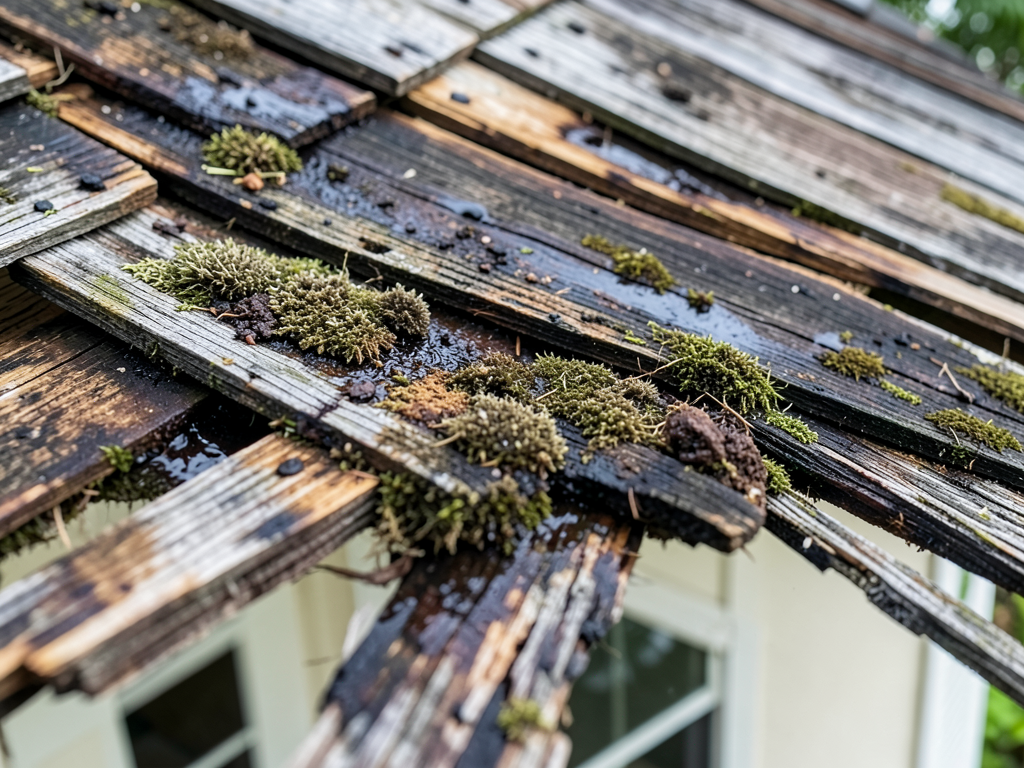
Inside your home, the attic often reveals the earliest evidence of moisture problems. Look for dark stains on the underside of plywood, especially near roof valleys and around penetrations like chimneys or vents. A musty odor that intensifies during humid weather strongly suggests active fungal growth. In severe cases, you may actually see mushrooms sprouting from the wood surface – a clear sign that the rot has progressed beyond repair.
Another critical warning sign involves your ceiling finishes. Water stains that appear after every heavy rain indicate compromised underlayment allowing moisture to reach the decking layer. These stains often start small but expand rapidly as the wood continues to deteriorate. Pay special attention to areas around light fixtures or ceiling fans, as these penetrations can accelerate water intrusion into weakened decking sections.
Miami’s Climate Creates Perfect Rot Conditions
The science behind roof decking failure in South Florida is straightforward but devastating. Miami’s average relative humidity exceeds 75% year-round, with summer months pushing past 90%. When warm, moisture-laden air contacts the cooler surface of roof decking, condensation forms continuously. This creates a perpetually damp environment where wood-destroying fungi thrive. Florida Building Code Information.
Daily temperature swings of 20-30 degrees Fahrenheit cause expansion and contraction cycles that create micro-fractures in the wood surface. These tiny cracks become entry points for moisture, which then travels deeper into the material through capillary action. The process accelerates dramatically when salt particles from coastal air mix with the moisture, creating a mildly acidic solution that breaks down wood fibers even faster.
South Florida’s afternoon thunderstorm pattern delivers another critical factor. Between June and September, brief but intense rainfall events dump several inches of water in under an hour. If your roof’s drainage system has any weakness – whether from clogged gutters, deteriorated flashing, or minor shingle damage – this concentrated water flow overwhelms the protection layers and reaches the decking. The constant wet-dry-wet cycle prevents the wood from ever fully drying, maintaining ideal conditions for rot throughout the rainy season.
Miami-Dade Building Code Requirements for Decking
Understanding local building requirements is crucial when addressing rotted roof decking in Allapattah homes. The Florida Building Code, specifically Chapter 15 for roofing, mandates specific standards for decking replacement in Miami-Dade County. For hurricane compliance, all roof deck replacements must include proper fastening patterns using ring-shank nails or screws at specified intervals – typically 6 inches on center along all supports. The Best Metal Roofing Options for Homes in Key Biscayne.
The code also requires a minimum plywood thickness of 5/8 inch for residential roof decks in the High-Velocity Hurricane Zone. This thickness provides the structural strength needed to withstand wind uplift pressures that can exceed 150 mph during major hurricanes. Using thinner material or improper fastening creates dangerous vulnerabilities that insurance companies specifically look for during claims inspections. Protecting Your Home with Hurricane Rated Roofing Systems in Miami.
Miami-Dade’s Notice of Acceptance (NOA) system adds another layer of requirements. Any new decking material must have specific product approvals showing it meets local wind resistance and moisture resistance standards. This includes testing for dimensional stability under prolonged humidity exposure – a critical factor given South Florida’s climate. Skipping these approvals can result in failed inspections and mandatory tear-offs, costing homeowners thousands in additional expenses. Why Homeowners in Coral Gables Choose Professional Tile Roof Installation.
Repair vs. Replacement Decision Guide
Determining whether to repair or replace rotted roof decking depends on several critical factors. Small, isolated areas of rot affecting less than 10% of the total deck area might qualify for targeted repairs. However, the rot must be caught early enough that the surrounding wood remains structurally sound. A professional inspection using moisture meters and physical probing helps determine the true extent of damage.
When rot affects 15% or more of the decking, or when multiple areas show advanced deterioration, complete replacement becomes the only safe option. This is especially true in Allapattah’s older homes where the existing decking may already be near the end of its service life. Partial replacement in these cases often leads to uneven performance and creates new failure points at the repair boundaries.
Consider the age of your roofing system as well. If your shingles are more than 15 years old and the decking shows significant rot, replacing both simultaneously makes financial sense. The labor overlap means you only pay for tear-off once, and you ensure your new waterproofing system protects fresh, structurally sound decking. Many Allapattah homeowners find that bundling these projects actually costs less than addressing them separately. Roofing Cutler Bay.
The Cost of Ignoring Wood Rot
Delaying repairs for rotted roof decking creates cascading problems that multiply repair costs exponentially. Once wood rot establishes itself, it spreads rapidly through the roof structure. What might cost $2,000-$3,000 to repair in the early stages can escalate to $10,000-$15,000 when rot reaches the roof trusses and requires structural repairs. The longer you wait, the more extensive the damage becomes.
Beyond direct structural damage, rotting decking creates ideal conditions for mold growth throughout your attic space. Miami’s humidity means mold colonies can establish themselves within 24-48 hours of moisture exposure. Once mold takes hold in the decking and spreads to insulation and drywall, remediation costs can exceed the original roof repair by several times. Some insurance companies may even deny claims for secondary damage if they determine the rot resulted from neglected maintenance.
Electrical systems in your attic face serious risks from advanced wood rot. As the decking deteriorates, it can expose or damage wiring, creating fire hazards and short circuits. The combination of moisture, decaying wood, and electrical current creates conditions for dangerous arcing that could ignite a house fire. These safety risks make timely inspection and repair not just a maintenance issue, but a critical safety concern for Allapattah families.
Preventing Future Decking Rot
Proper ventilation stands as your first line of defense against recurring roof decking rot. Miami homes need balanced attic ventilation systems that provide at least 1 square foot of net free ventilation area for every 150 square feet of attic floor space. This typically means installing ridge vents paired with soffit vents to create continuous airflow that carries moisture out before it can condense on the decking surface.
Regular roof maintenance prevents the small failures that lead to major rot problems. Schedule professional inspections twice yearly – once before hurricane season and once after. These inspections should include checking all flashing details, verifying sealant integrity around penetrations, and ensuring gutters and downspouts function properly. Catching a minor flashing leak early prevents the extensive water intrusion that causes decking rot.
Consider upgrading to modern moisture-resistant decking materials when replacement becomes necessary. Advantech or similar engineered panels offer superior moisture resistance compared to traditional plywood. While the upfront cost is higher, these materials resist swelling, delamination, and fungal growth much better than standard sheathing in Miami’s climate. The investment often pays for itself through extended service life and reduced maintenance needs.
Emergency Response for Compromised Decks
When you discover severe rot or active leaks, immediate action prevents catastrophic failure. The first 24-48 hours after discovering a problem are critical for limiting additional damage. Temporary tarping can prevent further water intrusion while you arrange for professional assessment, but it must be installed correctly to withstand Miami’s wind conditions.
Emergency tarping requires specific techniques to be effective in hurricane-prone areas. The tarp must extend at least 4 feet beyond the damaged area on all sides and be secured with 2×4 wood strips fastened through the tarp into the roof decking. Simple weight-based methods fail quickly in South Florida’s frequent thunderstorms. Professional emergency services understand these requirements and can properly secure temporary protection.
During the emergency response, document everything with photos and notes. This documentation proves invaluable for insurance claims and helps your contractor accurately assess the damage scope. Many Allapattah homeowners discover that what appeared to be a small leak actually affected a much larger decking area once the inspection reveals the full moisture pattern. Having clear before-and-after documentation streamlines the repair approval process.
Insurance Considerations for Rot Damage
Understanding your insurance coverage for rotted roof decking prevents unpleasant surprises during claims. Most standard homeowners policies in Miami-Dade County exclude damage from long-term neglect or lack of maintenance. If the insurance adjuster determines the rot resulted from years of ignored maintenance rather than a sudden storm event, your claim may be denied entirely.
However, if a named storm or sudden plumbing failure causes water damage that leads to decking rot, coverage typically applies to both the initial damage and resulting rot. The key is documenting the sudden nature of the event and showing you’ve maintained the roof properly before the incident. Keep all inspection reports and maintenance records to prove your diligence in roof care.
Some insurance companies now require proof of roof age and condition before issuing or renewing policies in South Florida. Homes with decking older than 20 years may face higher premiums or coverage restrictions. Proactive replacement of aging decking before it fails can actually reduce your insurance costs while preventing the emergency situations that lead to claim denials.
Professional Inspection Process
A thorough roof decking inspection involves multiple diagnostic techniques that reveal problems invisible from the ground. Professional inspectors use moisture meters to detect elevated moisture content in wood that appears visually sound. Readings above 20% moisture content indicate active rot conditions, even when no visual signs are present. This early detection capability saves homeowners from discovering problems only after catastrophic failure.
Infrared thermography provides another powerful diagnostic tool. Moisture in decking materials creates temperature differentials that show clearly on thermal imaging cameras. These scans can reveal the exact extent of water-damaged areas, helping contractors provide accurate repair estimates and avoid the costly mistake of replacing unaffected decking. The technology is particularly valuable in Allapattah’s mixed housing stock where building methods varied significantly over the decades.
Physical probing remains essential for confirming suspected rot areas. Using a screwdriver or specialized awl, inspectors test the wood’s resistance to penetration. Sound decking resists probing and feels solid, while rotted areas allow easy penetration with minimal pressure. This simple test, combined with moisture readings, provides definitive evidence of rot extent and helps determine whether repair or replacement is the appropriate solution.
Local Success Stories in Allapattah
Several Allapattah homeowners have successfully addressed chronic decking rot through comprehensive solutions. One NW 19th Avenue property discovered extensive rot during a routine inspection that revealed moisture levels exceeding 30% throughout the main roof section. Rather than patching individual areas, the owner opted for complete decking replacement with marine-grade plywood and upgraded ventilation. The $12,000 investment prevented an estimated $25,000 in emergency repairs that would have occurred within two years.
A nearby property on NW 22nd Avenue faced a different challenge – rot confined to roof valleys where water concentrated during heavy rains. The solution involved installing custom-fabricated metal valley liners over new decking sections, creating a permanent fix for the drainage problem that caused the original damage. This targeted approach cost approximately $6,000 but eliminated the chronic leaks that had plagued the home for years.
These local examples demonstrate that addressing roof decking rot requires understanding both the technical requirements and the specific conditions affecting each property. What works for a home near the industrial corridor differs from solutions appropriate for residential pockets closer to the health district. Local experience with Allapattah’s unique building patterns and moisture challenges proves invaluable for developing effective, lasting solutions.
Frequently Asked Questions
How can I tell if my roof decking needs replacement?
Look for sagging areas, soft spots when walking on the roof, water stains on ceilings, and musty odors in your attic. Professional moisture testing can detect problems before visible signs appear.
Does homeowners insurance cover rotted roof decking?
Coverage depends on the cause. Sudden storm damage is typically covered, but rot from neglect or lack of maintenance is usually excluded. Document all maintenance and inspections to support your claims.
How long does roof decking replacement take in Miami?
Most residential replacements take 2-3 days, weather permitting. Hurricane season may require additional precautions and scheduling flexibility due to frequent storms.
What building codes apply to roof decking in Allapattah?
Miami-Dade County requires 5/8 inch minimum plywood thickness, proper hurricane fastening patterns, and Notice of Acceptance approval for all materials in the High-Velocity Hurricane Zone.
Can I repair just the damaged sections of decking?
Small, isolated areas under 10% of total deck might be repairable. However, widespread or advanced rot requires complete replacement for safety and code compliance.
Take Action Before Your Decking Fails
Roof decking rot in Allapattah homes represents a serious threat that worsens rapidly in our humid climate. The combination of aging housing stock, extreme moisture conditions, and hurricane exposure creates perfect conditions for wood rot to develop and spread. What begins as a minor moisture problem can escalate to complete structural failure within a single rainy season.
Don’t wait until you notice ceiling stains or sagging rooflines. Professional inspection can identify moisture problems while they’re still manageable and affordable to fix. The cost of preventive assessment and early intervention pales compared to emergency repairs after catastrophic failure. Plus, addressing problems early means less disruption to your home and family routine.
Call (645) 231-4888 today to schedule your comprehensive roof decking inspection. Our experienced technicians understand Allapattah’s unique housing patterns and Miami-Dade’s strict building requirements. We’ll provide honest assessment of your roof’s condition and clear recommendations for protecting your home against our challenging climate. Don’t let another rainy season pass without ensuring your roof can withstand what South Florida throws at it.
You may also find this helpful. How the Overhanging Palm Trees at Your Snapper Creek Property Can Secretly Ruin Your Roof.
{
“@context”: “https://schema.org”,
“@type”: “BlogPosting”,
“headline”: “How Extreme Humidity Rots Roof Decking in Allapattah Homes”,
“description”: “Discover how Miami’s 90%+ humidity destroys roof decking in Allapattah homes. Learn warning signs, building code requirements, and when to call for inspection.”,
“wordCount”: 2562,
“datePublished”: “2026-04-06T06:07:00.000Z”,
“dateModified”: “2026-04-06T06:07:00.000Z”,
“inLanguage”: “en-US”,
“mainEntityOfPage”: {
“@type”: “WebPage”,
“@id”: “https://ironwoodroofingmiami.com”
},
“publisher”: {
“@type”: “LocalBusiness”,
“name”: “Ironwood Roofing Miami”,
“url”: “https://ironwoodroofingmiami.com”
},
“author”: {
“@type”: “Organization”,
“name”: “Ironwood Roofing Miami”,
“url”: “https://ironwoodroofingmiami.com”
},
“image”: {
“@type”: “ImageObject”,
“url”: “https://ironwoodroofingmiami.com/wp-content/uploads/2026/03/how-extreme-humidity-rots-roof-decking-in-allapatt-1.png”
}
}
{
“@context”: “https://schema.org”,
“@type”: “RoofingContractor”,
“name”: “Ironwood Roofing Miami”,
“url”: “https://ironwoodroofingmiami.com”,
“address”: {
“@type”: “PostalAddress”,
“addressLocality”: “Miami”
},
“areaServed”: {
“@type”: “City”,
“name”: “Miami”
}
}
{
“@context”: “https://schema.org”,
“@type”: “FAQPage”,
“mainEntity”: [
{
“@type”: “Question”,
“name”: “How can I tell if my roof decking needs replacement?”,
“acceptedAnswer”: {
“@type”: “Answer”,
“text”: “Look for sagging areas, soft spots when walking on the roof, water stains on ceilings, and musty odors in your attic. Professional moisture testing can detect problems before visible signs appear.”
}
},
{
“@type”: “Question”,
“name”: “Does homeowners insurance cover rotted roof decking?”,
“acceptedAnswer”: {
“@type”: “Answer”,
“text”: “Coverage depends on the cause. Sudden storm damage is typically covered, but rot from neglect or lack of maintenance is usually excluded. Document all maintenance and inspections to support your claims.”
}
},
{
“@type”: “Question”,
“name”: “How long does roof decking replacement take in Miami?”,
“acceptedAnswer”: {
“@type”: “Answer”,
“text”: “Most residential replacements take 2-3 days, weather permitting. Hurricane season may require additional precautions and scheduling flexibility due to frequent storms.”
}
},
{
“@type”: “Question”,
“name”: “What building codes apply to roof decking in Allapattah?”,
“acceptedAnswer”: {
“@type”: “Answer”,
“text”: “Miami-Dade County requires 5/8 inch minimum plywood thickness, proper hurricane fastening patterns, and Notice of Acceptance approval for all materials in the High-Velocity Hurricane Zone.”
}
},
{
“@type”: “Question”,
“name”: “Can I repair just the damaged sections of decking?”,
“acceptedAnswer”: {
“@type”: “Answer”,
“text”: “Small, isolated areas under 10% of total deck might be repairable. However, widespread or advanced rot requires complete replacement for safety and code compliance.”
}
}
]
}
{
“@context”: “https://schema.org”,
“@type”: “BreadcrumbList”,
“itemListElement”: [
{
“@type”: “ListItem”,
“position”: 1,
“name”: “Home”,
“item”: “https://ironwoodroofingmiami.com”
},
{
“@type”: “ListItem”,
“position”: 2,
“name”: “Blog”,
“item”: “https://ironwoodroofingmiami.com/blog”
},
{
“@type”: “ListItem”,
“position”: 3,
“name”: “How Extreme Humidity Rots Roof Decking in Allapattah Homes”
}
]
}
{
“@context”: “https://schema.org”,
“@type”: “Service”,
“serviceType”: “Roofing”,
“provider”: {
“@type”: “LocalBusiness”,
“name”: “Ironwood Roofing Miami”,
“url”: “https://ironwoodroofingmiami.com”
},
“areaServed”: {
“@type”: “City”,
“name”: “Miami”
},
“description”: “Discover how Miami’s 90%+ humidity destroys roof decking in Allapattah homes. Learn warning signs, building code requirements, and when to call for inspection.”
}